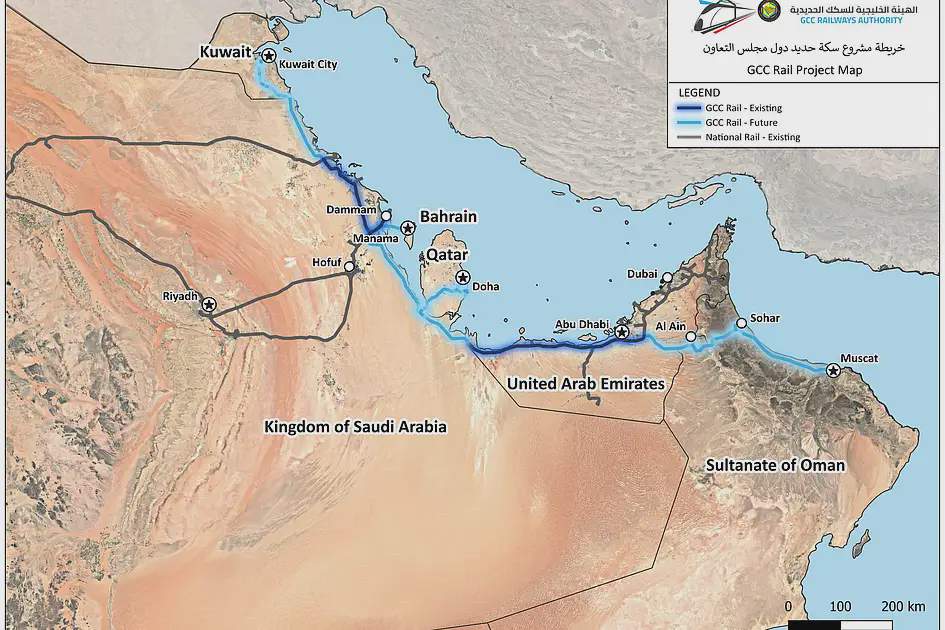
The six member states of the Gulf Cooperation Council — the UAE, Saudi Arabia, Oman, Qatar, Kuwait and Bahrain — signed a general agreement on Sunday in Manama to formalise the long-planned GCC Railway, a regional rail network connecting all six countries. The ceremony brought together transport and communications ministers from each state along with GCC Secretary-General Jasem Albudaiwi, hosted by Bahrain in its capacity as current holder of the GCC presidency.
The planned network stretches more than 2,100 kilometres and is designed to carry both passengers and freight across the six countries on a single integrated line. Passenger trains are expected to run at speeds of up to 200 km/h, while freight services will operate between 80 and 120 km/h. As of June this year, roughly half of the project's construction had been completed, with the full network targeted for operational completion by the end of 2030.
The agreement signed in Manama sets out the operational and implementation procedures for the network, defines the responsibilities of each member state, and strengthens coordination with the GCC Railways Authority, the body tasked with monitoring construction progress and resolving obstacles as they arise. Officials describe the project's purpose as providing safe, economical and environmentally friendly transport for both people and goods while deepening trade, economic and social ties among the six Gulf states.
The railway also carries strategic weight for the region, offering an alternative to maritime routes through the Strait of Hormuz, a chokepoint that handles a significant share of the world's daily oil shipments and regional trade. Once complete, the network is expected to give residents of the UAE and Dubai a faster and cheaper land link to neighbouring Gulf states, reducing reliance on air travel and sea freight for cross-border movement within the GCC.
For fast, reliable access to our news and stories, download and install the latest version of our app.
Download the app